- Home
-

- Blog
-
- News and Industry Updates
-
- Google Adds AI Review Summaries as TikTok and Meta Drop Big Ad Updates
Google Adds AI Review Summaries as TikTok and Meta Drop Big Ad Updates

Keeping up with digital marketing updates can feel like trying to drink from a firehose. This month is no exception, as tech giants like Google, Meta and TikTok roll out profound changes that might reshape how you connect with customers.
At OMG, we have our finger on the pulse of AI, SEO and social media marketing updates so you don’t have to. Let’s dive in.
Key Takeaways
-
Google brings AI review summaries directly to Chrome: U.S. desktop users shopping retail sites now see instant, AI-powered snapshots of customer reviews, sourced from platforms like Trustpilot and Bazaarvoice, right from the browser.
-
Google launches AI Max Ads: Google’s latest ad format lets AI automatically build ads using content from your entire website, including blog posts and long-form pages. Headlines and sitelinks are dynamically generated to deliver hyper-relevant ads at scale.
-
TikTok boosts its retargeting toolkit: New options allow granular audience targeting based on specific site actions, moving TikTok beyond awareness to a true conversion engine.
-
NotebookLM supercharges content repurposing: Google’s AI tool can now break down YouTube videos into scripts, summaries and key points, slashing research and content creation time.
-
TikTok redefines what matters with ‘Engaged Sessions’: Quality engagement now beats empty view counts. Marketers gain clearer data on what actually resonates.
-
Meta’s AI can override your ad destination URL: Meta can now users to whichever page is most likely to convert, putting your entire website under the microscope.
-
X (Twitter) reinvents ads with Grok and trust-driven features: Ads now get an aesthetic score, less clutter and new transparency tools for users.
1. Google adds AI-powered review summaries in Chrome

Google has just flipped the script on online reputation. And right inside Chrome. U.S. users browsing retail sites on desktop can now see an AI-generated review summary just by clicking the info icon next to the URL bar. Chrome distills feedback from major sources like Trustpilot, Bazaarvoice, ScamAdviser and others into a summary that covers product quality, pricing, shipping, customer service, returns and your Google star rating.
It’s one of the most practical AI marketing tools to impact local search in years, and it directly influences brand trust and visibility from the get-go. A strong, positive summary can dramatically boost credibility and clicks, while a summary with negative patterns can stop a customer journey in its tracks.
The Gurus’ take on what this means for your SEO
The opportunity here is immense: businesses that master their review ecosystem can gain an edge. While it’s only for retail sites at the moment, we believe Google is collapsing the wall between advertising and operations. For years, businesses could get by with slick marketing even if delivery was subpar. That time is over.
More than an AI marketing tool, it’s an operational scorecard. Every slow shipment or stellar customer service moment is now a potential data point for a summary you can’t control. Google used to just send traffic to your digital doorstep. Today, it’s telling customers whether it’s even worth knocking.
Your action plan
You can’t edit these summaries, but you can influence them. Here are some steps we recommend in this new frontier of AI SEO:
- Be a review conductor: Actively encourage your happiest customers to leave detailed reviews. Prompt them to mention specific products or aspects of your service they loved.
- Engage with everyone: Respond professionally and promptly to all reviews, both good and bad. This signals to Google that you are an active, customer-centric business. For a small shop, this might be a 20-minute task each morning. Operations at scale can consider a specialised “Digital Reputation” team within their Customer Service department.
- Think in themes: Identify the key positive themes you want the AI to pick up on (e.g., “fast shipping,” “friendly staff,” “great value”) and weave them into your customer communications.
2. Google rolls out AI Max Ads
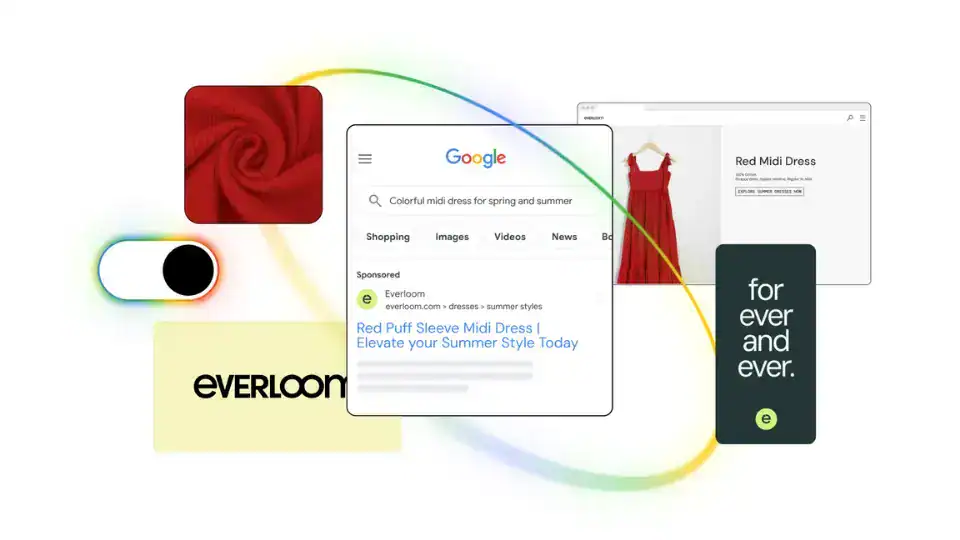
Google is evolving its ad platform beyond Performance Max with a new, even more autonomous format: AI Max Ads. More than an automated campaign type, it’s an AI agent given the keys to your entire content library. It automates bidding and targeting, and now, it can also pull content directly from your blog posts and other website pages to dynamically generate ad copy.
What’s new is how it constructs these ads. We’re seeing significantly longer headlines than standard formats allow, with ad copy sourced directly from in-depth articles. The AI also dynamically generates sitelinks, moving beyond the manual setup advertisers are used to.
The Gurus’ take on how this affects the PPC game
This is a game-changer because it directly ties your content marketing efforts to your paid search performance in a way we’ve never seen before. Your blog was primarily an SEO asset for organic traffic. Now, every well-written article is also potential fuel for a high-performing search ad.
Early reports suggest this approach is driving significantly higher ROAS because the AI can match a user’s highly specific query with the nuanced, long-tail information found only in your articles. In other words, it creates hyper-relevant ads on the fly. This is one of those digital marketing updates that forces a complete rethink of the value of your content archives.
Your action plan
To prepare for the broader rollout of this powerful AI marketing tool, you need to treat your entire website as an ad creative asset.
- Audit your content library: Your blog archives just became a goldmine. Review your top-performing articles for clarity, strong messaging and compelling information. The AI will use this material, so make sure it’s ready for primetime.
- Embrace URL expansion: When this feature is available, begin testing campaigns with final URL expansion turned on. This gives the AI permission to hunt through your site for the best content to use in your ads.
- Watch ad previews closely: This is your new quality control. Regularly use the ad preview tool to see what content the AI is pulling and how it’s presenting it.
3. TikTok steps up its game with website visitor retargeting

Just when you thought Meta had the final word on retargeting, TikTok has started testing powerful new options for re-engaging website visitors. This lets advertisers create much more granular custom audiences based on specific actions users took on their site, moving beyond simple page views.
This is one of the most important social media marketing updates for e-commerce and lead-gen brands. For a long time, TikTok’s power was in top-of-funnel awareness. Now, it’s making a serious play for the rest of the funnel. Targeting users who added an item to their cart but didn’t buy, or who visited a key landing page, gives advertisers a tool to drive conversions.
The Gurus’ take on website visitor retargeting
What we’re seeing here is the platform’s graduation from a brand awareness playground to a full-fledged conversion engine. For years, the challenge was connecting a viral TikTok video to a tangible sale. This digital marketing update could be the missing link to systematically guide users from initial discovery all the way to purchase.
The way we see it, every retargeting signal you collect (every page view and every purchase) is also a data point that educates TikTok’s organic ‘For You’ Page algorithm. More than just powering your own campaigns, you’re teaching the platform to get better at identifying users with commercial intent. This can create a feedback loop where better ad data can lead to a smarter, more commercially-driven organic feed over time.
Your action plan
Ready to build stronger ad funnels on TikTok? Here’s where to start.
- Install the pixel correctly: This is non-negotiable. Ensure your TikTok Pixel is installed on your website and that you’ve set up standard events like ViewContent, AddToCart and Purchase.
- Segment your audiences: When this feature is fully rolled out, don’t just retarget all website visitors. Create distinct audiences: users who visited in the last 7 days, users who viewed a specific product category and high-intent users who abandoned their cart.
- Tailor your creative: Serve your cart abandoners a different ad than your general website visitors. Offer a discount, showcase a testimonial or highlight your free shipping policy to give them that final nudge.
4. Google upgrades NotebookLM with video AI assistance

Google is continuing to infuse AI into every corner of its ecosystem, and content creation is next. NotebookLM, Google’s AI-powered research assistant, just received a major boost: it can now understand and create overviews from YouTube videos and other visual sources.
For content creators and marketers, this is a massive efficiency play. Imagine being able to drop a link to a 45-minute webinar and instantly get a script, a summary and a list of key timestamps. These new features are powerful AI marketing tools to help you repurpose and scale content creation like never before. Instead of spending hours re-watching and transcribing, you can now generate derivative content like blog posts, social media clips and presentation notes in a fraction of the time.
The Gurus’ take on what this could do for your marketing
The low-hanging fruit here is content repurposing, but we believe the real genius move is to turn this tool outward. Think of it as your new competitive intelligence engine. You can now ingest a competitor’s hour-long product webinar and instantly receive a deconstruction of their core strategy, value propositions and customer pain points.
Furthermore, this represents a massive leap forward for AI SEO. For years, the rich, valuable information spoken in videos has been like ‘dark data’ that’s incredibly difficult for search engines to fully access and index. This AI marketing tool finally bridges that gap.
Your action plan
This is your chance to stop the content creation grind and start working smarter.
- Conduct a content audit: Identify your top-performing long-form video content on YouTube. These are your prime candidates for repurposing.
- Generate new formats: Use NotebookLM to pull a full transcript from a video. Then, ask it to turn that transcript into a draft for a blog post, a series of tweets or a LinkedIn article. This is where AI and SEO meet content strategy.
- Accelerate research: Use the tool to quickly get the gist of any video relevant to your industry. You can analyse competitor videos or research new topics without having to watch them in their entirety.
5. TikTok wants you to focus on ‘Engaged Sessions’

TikTok is refining how creators and advertisers measure success by launching a new metric: “Engaged Session.” This tool provides a much clearer picture of what your audience finds interesting, moving beyond the vanity of simple view counts.
This is a fantastic social media marketing update because it prioritises quality over quantity. An Engaged Session is a metric that looks at signals like time watched and user interactions within a single viewing session. It filters out passive or accidental views.
This matters because it gives you a much more accurate signal for content performance. By optimising for engaged sessions, you aim for genuine audience connection, which is a far better predictor of brand affinity than a simple view count.
The Gurus’ take on the Engaged Session tool
This is a deliberate market correction from TikTok. For too long, brands have chased hollow virality and celebrated massive view counts that often had zero real business impact. The “Engaged Session” is TikTok’s way of saying the era of viral vanity is over. They’re recalibrating the definition of success on their platform away from “Did they see it?” and towards “Did they care?”.
Our decade-long experience tells us new metrics always pave the way for new ad products. We see this as the foundational step toward future attention-based bidding models. Don’t be surprised if “Cost Per Engaged Session” (CPES) becomes a bidding option down the line. In short, advertisers might only pay for focused attention instead of passive glances.
This social media marketing update also transforms your analytics dashboard into a creative director. It gives you the diagnostic data to deconstruct why a hook lands or a particular story resonates.
Your action plan
Use this new data to sharpen your content and campaign strategy.
- Identify your true winners: Dive into your analytics and sort your content by “Engaged Sessions,” not just views. The results might surprise you. This is your new gold standard for what resonates.
- Analyse engagement patterns: Look at the videos with the highest engagement. What do they have in common? Is it a particular format, topic or hook? Double down on those elements.
- Refine your ad campaigns: Use your most engaging organic videos as the creative for your ad campaigns. If a video can hold an audience’s attention organically, it’s far more likely to perform well as a paid ad.
6. Meta can override your destination URL with website optimisation

In a move showing just how confident Meta is in its AI, the platform can now override the destination URL you set in your ads. For specific conversion-focused campaigns, if Meta’s AI believes a different page on your website offers a higher chance of converting a particular user, it will send them there instead. This feature is available when you have a sales objective, an active product catalogue and a website conversion location, and if you use a single image or video ad format.
This works by leveraging the immense data from your Meta Pixel and overall site structure. The AI analyses user behaviour, page content and conversion history across your domain. When it identifies a user who, based on their profile, is more likely to respond to a product page instead of the category page you linked in the ad, it will dynamically change the ad’s destination to send them directly to that higher-intent page. This is one of the most hands-on digital marketing updates we’ve seen from any platform.
The Gurus’ take on Meta’s URL override feature
This feature is less of an ad tool and more of a “forced honesty” policy for your website. For years, marketers could get away with having one hyper-optimised landing page while the rest of the site was mediocre. Meta’s AI is now calling that bluff. It effectively turns into an automated, aggressive website auditor who exposes weak links in your UX. If your site isn’t consistently strong, the AI will find the best corner to send traffic to if you enable this feature.
The deeper angle here is about trust and control. By enabling this feature, you’re ceding a fundamental piece of strategic control to a black-box algorithm. This requires immense trust in Meta’s data and its AI’s decision-making. On a positive note, it could be seen as another step towards a future where marketers manage high-level goals and provide creative assets, while the AI handles almost all of the tactical execution. This shift has massive implications for attribution and requires a new level of faith in the machine.
Your action plan
This is where your AI SEO strategy must be flawless.
- Conduct a full site audit: Every potential landing page on your site is now an ad destination. Audit all of them for conversion-readiness, clear messaging and fast load times.
- Ensure message consistency: The AI is looking for the best match for the user. Ensure your product descriptions, value propositions and calls-to-action are consistent across your site.
- Strengthen site structure: Use a clear and logical site hierarchy. Make it easy for both users and Meta’s AI to understand the relationship between your pages.
- Monitor your reports: Keep a close eye on your ad reports to see which pages Meta is favouring. This is free data telling you what the AI considers your most effective landing pages.
7. X launches smarter, trust-focused ads with Grok

X is making a significant play to enhance its advertising platform by integrating its powerful AI, Grok, with a renewed focus on quality and trust. The goal is to make advertising smarter and more relevant by leveraging Grok’s real-time understanding of conversations, while also cleaning up the user experience with sleeker, less intrusive ad formats.
The system now goes beyond just real-time targeting. Ads are being redesigned to remove clutter and will be assigned an “aesthetic score” that can influence pricing, directly incentivising higher-quality creative. Furthermore, by expanding Grok’s “Explain this post” feature to ads, X is giving users a tool to get more context and transparency.
The Gurus’ take on X’s AI ad integration
This is a two-pronged strategy to solve X’s biggest challenges: rebuilding advertiser trust and empowering SMBs. Companies have been wary of brand safety on the platform. By introducing an aesthetic score and transparency tools, X is attempting to curate a more premium ad environment. It’s rewarding quality and giving users tools to verify claims, which in turn makes the platform a safer bet for advertisers.
This move is also a critical lifeline to SMBs. By using AI marketing tools like Grok to simplify ad creation and improve targeting, X is lowering the barrier to entry. It’s offering small businesses a way to create high-quality, relevant ads that can compete for attention, without needing a massive creative team or a 24/7 social media manager to monitor trends.
Your action plan
Success with this new AI marketing tool requires a dual focus on agility and quality.
- Prioritise ad quality: Your ad’s visual appeal now directly impacts its cost and reach. Invest in high-quality, visually clean creatives that feel native to a more premium timeline.
- Embrace transparency: With the “Explain this post” feature on ads, your messaging must be clear and defensible. Be prepared for users to seek more context about your brand and offers.
- Use Grok as a creative spark: Treat the AI’s suggestions for tapping into real-time trends as a starting point. Your job is to infuse those insights with your unique brand voice and high-quality creative.
- Think like a premium brand: A strong SEO presence is about discoverability and authority. Align your ad strategy on X with this principle. Focus on adding value to conversations and building trust, knowing the platform itself is now designed to reward that approach.
Final thoughts: your strategy in the age of AI
As we’ve seen, the pace of digital marketing updates is only accelerating, with AI at the heart of every major shift. From search and social to content creation, these new systems reshape the very definition of marketing. Success with new AI marketing tools requires forming a powerful partnership between human creativity and machine intelligence.
Feeling a bit overwhelmed by these updates? Don’t be. Mastering these updates and turning them into growth opportunities is precisely what we live for. It’s the passion that fuels our work and helps fill our trophy case. And we’re proud to say that includes our most recent award as 2025 SEO Agency of the Year.
Contact Online Marketing Gurus today, and let’s turn these new realities into your unfair competitive advantage.

About the Author
Andrew Raso
Share